





















































































































































Green Tea for Weight Management: What Research Really Shows
Author: RVLNSV PRASAD
Updated: September 2026
About Us
Author Bio
Editorial Policy
Contact Us
Medical disclaimer
This article is for educational purposes only. Green tea is not a treatment for obesity or a substitute for a balanced eating pattern, physical activity, or medical care. If you are considering concentrated green tea extracts or have a medical condition or take medicines, discuss them with a qualified healthcare professional.
Quick Answer
Green tea for weight management may offer a small benefit, but it is not a magic fat-burning drink.
Green tea contains catechins, including epigallocatechin gallate (EGCG), as well as caffeine. Researchers have investigated whether these compounds can influence energy expenditure, fat oxidation, and body weight. Current evidence suggests that any effect on weight is likely to be modest, and results vary between studies. The National Institutes of Health Office of Dietary Supplements describes green tea as having a possible modest effect on body weight rather than a dramatic one. NIH Office of Dietary Supplements — Dietary Supplements for Weight Loss
There is another important detail that is often missed online: much of the research has examined green tea extracts or standardized preparations rather than ordinary cups of brewed tea. NCCIH specifically notes this distinction and also warns that concentrated extracts have different safety considerations from green tea consumed as a beverage. NCCIH — Green Tea: Usefulness and Safety
So, rather than asking whether green tea “burns fat,” a better question is:
How much can green tea realistically contribute to weight management, and what part of the benefit may actually come from replacing higher-calorie drinks with an unsweetened beverage?
That is the question this article explores.
Key Takeaways
- Green tea contains catechins and caffeine, which have been studied for possible effects on energy expenditure and fat oxidation.
- Research suggests that green tea may contribute to a small or modest change in body weight, rather than rapid weight loss. NIH ODS
- Not every study has found meaningful weight-loss effects, so the evidence should not be presented as conclusive. Healthline’s evidence review
- Replacing a sugary beverage with unsweetened green tea may be a practical weight-management strategy because it can remove calories from the overall diet.
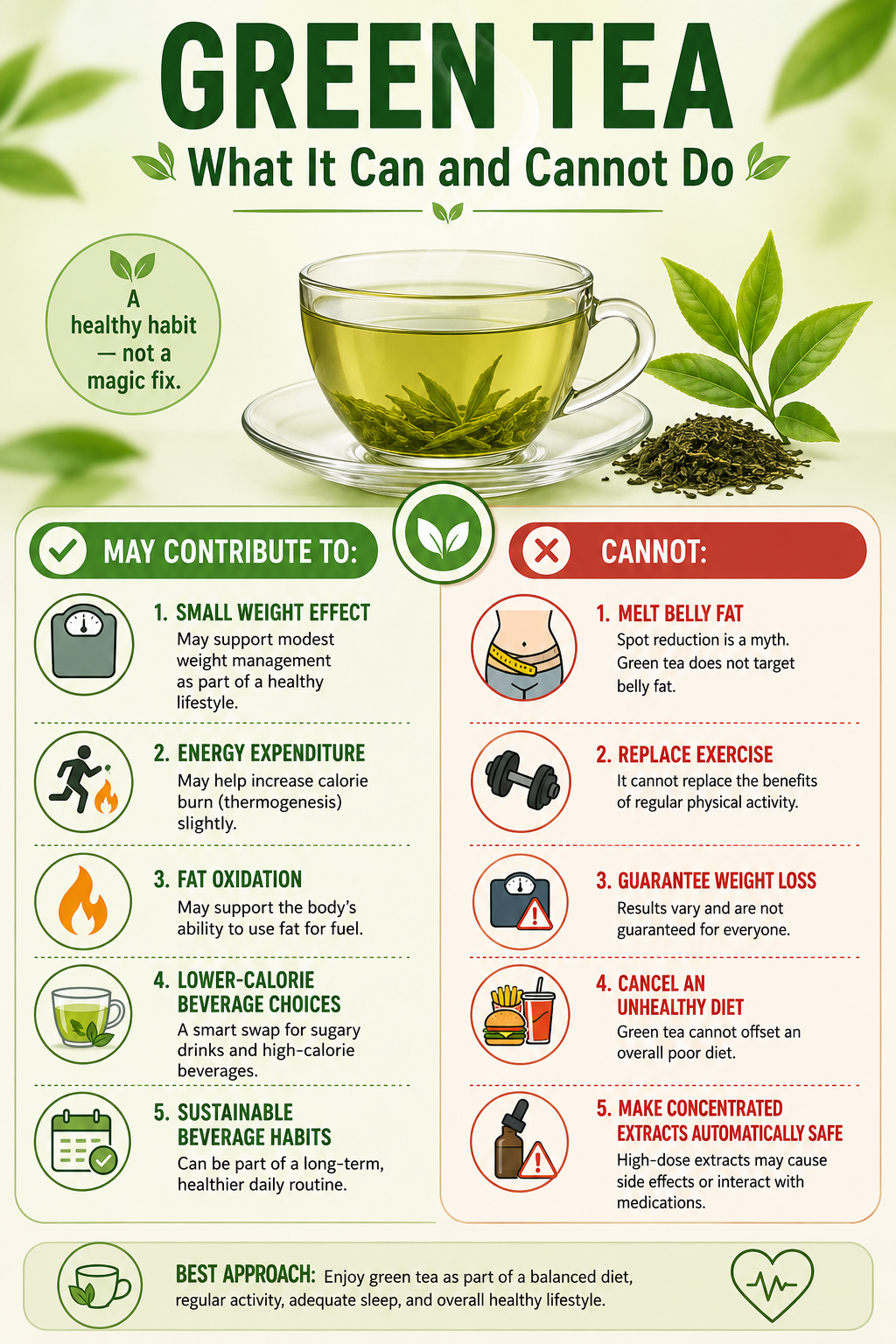
- Green tea cannot selectively burn belly fat.
- Drinking more green tea does not automatically mean losing more weight.
- Brewed green tea and concentrated green tea extract are not interchangeable.
- Green tea extracts have additional safety concerns, including uncommon reports of liver injury. NCCIH
- The most realistic role for green tea is as one small part of a sustainable weight-management routine.
Introduction: Is Green Tea Really a Weight-Loss Drink?
A cup of green tea can look almost too simple to attract so much attention.
There are no complicated ingredients to prepare, no elaborate recipe, and, when consumed without sugar or other calorie-containing additions, very little energy in the drink itself. Yet green tea has become closely associated with metabolism, fat burning, and weight loss.
That popularity raises an important question.
Is the tea itself responsible for meaningful weight loss, or is the story more complicated?
The answer is somewhere in the middle.
Green tea contains compounds that can influence biological processes involved in energy use. Researchers have therefore investigated catechins, particularly EGCG, together with caffeine. Some studies have reported favorable changes in body weight or body composition, while others have found little or no meaningful effect.
Current evidence does not support treating green tea as a powerful standalone weight-loss intervention. NIH’s Office of Dietary Supplements describes the potential effect as modest, while NCCIH notes that most studies have examined extracts rather than the beverage people normally drink. NIH ODS NCCIH
That distinction changes how we should talk about green tea.
Instead of promising dramatic results, it makes more sense to examine potential effect, evidence strength, and real-world meaning.
My Personal Experience With Green Tea
My interest in green tea began with a very ordinary habit change.
A few years ago, I decided to reduce my intake of sugary soft drinks and replace them with green tea. At first, I found the taste quite different from the sweet drinks I was accustomed to. Over time, however, I became comfortable drinking it without adding sugar.
What I noticed most was not some dramatic change in body weight.
The bigger change was that I had replaced a calorie-containing drink with a beverage that could be consumed without adding sugar. That also made me more conscious of some of my other food choices.
That experience made me curious about the science.
Was green tea itself responsible for weight-related changes, or was the bigger benefit simply the change in my beverage habits?
When I looked more closely at the research, the answer became much less dramatic than many online claims suggest. Green tea may have a modest biological effect, but the overall impact appears small compared with the importance of eating patterns, physical activity, sleep, and long-term consistency.
That distinction is important because personal experience can tell us what happened in one person’s routine, but it cannot prove what caused it.
What Is Green Tea?
Green, black, and oolong tea all come from the same plant, Camellia sinensis. They differ mainly in how the leaves are processed.
Green tea is produced without the fermentation used to make black tea. NCCIH—Green Tea
Green tea contains several naturally occurring compounds, including
- Catechins
- EGCG
- Caffeine
- Other polyphenols
- L-theanine and other plant compounds
For weight-management research, two components receive particular attention:
Catechins
Catechins are polyphenolic compounds found in tea. EGCG is one of the best-studied catechins in green tea.
Caffeine
Caffeine is a stimulant that can temporarily influence alertness and energy expenditure.
NIH ODS notes that the components associated with green tea’s potential weight effects include caffeine and catechins, particularly EGCG. NIH ODS
But identifying a biological mechanism is only the beginning.
The more important question is whether those effects are large enough to produce meaningful changes in a person’s weight.
Why Has Green Tea Been Studied for Weight Management?
Researchers have proposed several possible mechanisms.
Green tea catechins and caffeine may influence:
- Energy expenditure
- Thermogenesis
- Fat oxidation
- Fat metabolism
- Some pathways involved in energy balance
NIH ODS notes that green tea and its components have been studied for possible effects on energy expenditure, fat oxidation, fat formation, and fat absorption.
But there is a crucial scientific distinction:
A plausible mechanism does not automatically produce clinically meaningful weight loss.
For example, a compound may slightly increase energy expenditure under controlled conditions. That does not mean a person will lose several kilograms simply by drinking tea.
This is one of the most important ideas to keep in mind when reading green-tea weight-loss claims.
12 Evidence-Based Ways Green Tea May Fit Into Weight Management
1. It May Contribute to a Small Change in Body Weight
This is the most important potential benefit to discuss, but it needs realistic wording.
Green tea is not proven to cause dramatic weight loss.
NIH ODS describes green tea and green tea extract as having a possible modest effect on body weight. NIH ODS — Weight Loss Supplements
Some systematic reviews have found small reductions in weight-related measurements, while other research has found weaker or inconsistent effects.
This variation matters.
If a person drinks green tea and loses weight, that does not automatically mean the tea caused the entire change.
Diet, physical activity, sleep, calorie intake, and other behaviors can have much larger effects.
Real-world meaning
Think of green tea as a possible small contributor, not the main engine of weight loss.
2. It May Influence Energy Expenditure
Your body uses energy continuously, including when you are resting.
Researchers have studied whether green tea catechins and caffeine can temporarily increase energy expenditure.
Some controlled studies support this possibility. NIH ODS reports evidence that caffeine and catechins can increase energy expenditure compared with placebo under certain conditions.
However, even when an increase in energy expenditure occurs, the size and duration of that effect matter.
A temporary physiological change should not be translated into:
“Green tea dramatically speeds up metabolism.”
That is an oversimplification.
Real-world meaning
Green tea may influence energy expenditure slightly, but it should not be viewed as a replacement for the fundamentals of weight management.
3. It Provides Catechins Such as EGCG
EGCG is one reason green tea attracts so much scientific attention.
Catechins are plant compounds with biological activity, and EGCG is particularly well studied.
Some research has examined whether catechins affect fat oxidation, energy expenditure, and body composition.
But there is a common mistake here:
More EGCG does not automatically mean more weight loss.
Research on green tea preparations differs in concentration, formulation, duration, and participant characteristics.
That makes it difficult to translate laboratory or supplement findings into a simple “one cup equals X calories burned” formula.
Real-world meaning
EGCG makes green tea scientifically interesting, but it does not make the beverage a guaranteed fat burner.
4. Its Caffeine May Contribute to the Effect
Green tea naturally contains caffeine.
Caffeine can stimulate the central nervous system and influence energy expenditure. NIH ODS notes that caffeine can increase thermogenesis and may contribute to fat oxidation, although habitual caffeine consumption can reduce some of these effects through tolerance. NIH ODS
This may partly explain why some research involving catechins plus caffeine produces different results from studies involving catechins alone.
However, caffeine is not unique to green tea. Coffee and several other beverages also contain it.
Real-world meaning
Green tea’s caffeine content may contribute to its physiological effects, but caffeine alone is not a weight-loss solution.
5. It May Affect Some Measures of Body Composition
Weight is only one measurement.
Researchers have also examined:
- Body fat
- BMI
- Waist circumference
- Fat oxidation
- Other body-composition measures
Some reviews report favorable changes, but the results are not uniform.
Healthline’s current evidence review similarly notes that research on green tea and weight loss is mixed and that the effects on actual pounds lost are relatively modest. Healthline — How Green Tea Can Help You Lose Weight
Real-world meaning
A change in one body-composition measurement does not necessarily translate into a dramatic transformation.
6. It Can Replace Higher-Calorie Drinks
This may be one of the most practical benefits of green tea.
Imagine two beverage habits.
Habit A: Regularly drinking a sugar-sweetened beverage.
Habit B: Drinking unsweetened green tea instead.
In Habit B, the person may reduce calorie intake because the original calorie-containing drink has been removed.
The important point is that the benefit may come largely from the substitution, rather than green tea performing a powerful fat-burning action.
NIH ODS emphasizes that proven approaches to weight loss include healthy eating, reducing calorie intake when appropriate, and physical activity. NIH ODS Consumer Fact Sheet
Real-world meaning
Sometimes the smartest “weight-loss drink” is simply the one that helps you stop drinking something with substantially more calories.
7. It Can Be a Low-Calorie Beverage Choice
Unsweetened green tea can fit easily into a lower-calorie eating pattern.
That does not mean the tea actively melts body fat.
It means the beverage can provide flavor without requiring the calories that come from sugar-sweetened drinks.
This distinction may sound small, but repeated beverage choices can become meaningful over time.
A useful question
Instead of asking:
“How much fat does green tea burn?”
Ask:
“What higher-calorie drink could green tea replace?”
That question may produce a more practical answer for everyday weight management.
8. It May Fit Into a Sustainable Routine
A weight-management routine has to be realistic enough to continue.
For some people, preparing a cup of tea is easy to repeat. That simplicity can make it easier to replace less nutritious beverage choices.
However, the benefit comes from the overall routine.
If green tea is consumed alongside a high-calorie diet, little physical activity, and frequent sugary drinks, the tea itself is unlikely to overcome those factors.
Real-world meaning
A sustainable habit is useful when it supports the rest of your routine—not when it is expected to compensate for everything else.
9. It Provides Plant Polyphenols
Green tea contains polyphenols, including catechins.
These compounds are one reason green tea has attracted research beyond weight management.
However, antioxidants and polyphenols should not automatically be described as weight-loss agents.
This is another area where health articles sometimes blur two separate ideas:
“This food contains beneficial compounds.”
and
“This food causes meaningful weight loss.”
They are not the same statement.
10. It May Complement Physical Activity
Some research has examined green tea or its components in combination with exercise.
The findings are mixed.
Healthline’s evidence review notes that research on green tea and fat burning during exercise has produced inconsistent results, with some studies reporting an effect and others not finding significant changes. Healthline
So I would not recommend thinking:
“I can drink green tea before exercise and burn dramatically more fat.”
A better interpretation is
Green tea may complement an active lifestyle, but exercise itself remains the important intervention.
11. It Can Encourage Better Beverage Habits
For some people, the value of green tea is behavioral.
A person who develops a preference for unsweetened tea may gradually drink fewer sugary beverages.
That is a meaningful lifestyle change even if green tea’s direct effect on metabolism is small.
This is particularly relevant because weight management is rarely determined by one food or drink.
It is shaped by repeated choices.
Real-world meaning
If drinking green tea helps you make better beverage choices consistently, that may be more useful than chasing a supposed “fat-burning” effect.
12. It Can Be One Small Part of Long-Term Weight Management
The most realistic conclusion is also the least sensational.
Green tea can be part of a healthy routine.
It may contribute a modest physiological effect, provide a low-calorie beverage option, and help some people replace sugary drinks.
But long-term weight management still depends on a broader pattern involving food, movement, sleep, behavior, and, when appropriate, professional support.
The bigger picture
Green tea is a supporting habit—not the strategy itself.
What the Evidence Really Says
The evidence becomes much easier to understand when we separate claims into levels.
| Claim | Evidence assessment | What it means |
|---|---|---|
| Green tea causes dramatic weight loss. | Not supported | Do not expect major changes from tea alone. |
| Green tea may produce a small weight effect. | Possible | Some evidence supports a modest effect. |
| Catechins and caffeine affect energy expenditure. | Supported under some conditions | Biological effects have been observed. |
| Green tea specifically burns belly fat. | Not established | It cannot be treated as a spot-fat-loss method. |
| Green tea replaces exercise. | No | Physical activity remains important. |
| Green tea can replace sugary drinks. | Practical strategy | The calorie reduction comes mainly from the substitution. |
| Green tea extract is better than brewed tea. | Not established | Extracts have different concentrations and safety issues. |
| More tea means more weight loss. | Not established | Higher intake is not automatically better |
NIH ODS characterizes the potential weight effect of green tea as modest, while NCCIH emphasizes that most studies have evaluated extracts rather than ordinary beverages.
Why Do Green Tea Studies Produce Different Results?
If green tea works, why don’t all studies show the same thing?
There are several possible reasons.
1. Different preparations
One study may use brewed tea while another uses a concentrated extract.
Those are not equivalent.
2. Different catechin concentrations
The amount and composition of catechins can vary.
3. Different caffeine exposure
Caffeine can contribute to some metabolic effects, but people respond differently, and tolerance can develop.
4. Different participants
Age, body composition, diet, activity level, and habitual caffeine consumption can influence results.
5. Different study lengths
A short-term physiological change does not necessarily produce meaningful long-term weight loss.
6. Different study designs
A small controlled trial and a large systematic review answer different questions.
This is why one exciting study should not be treated as the final word.
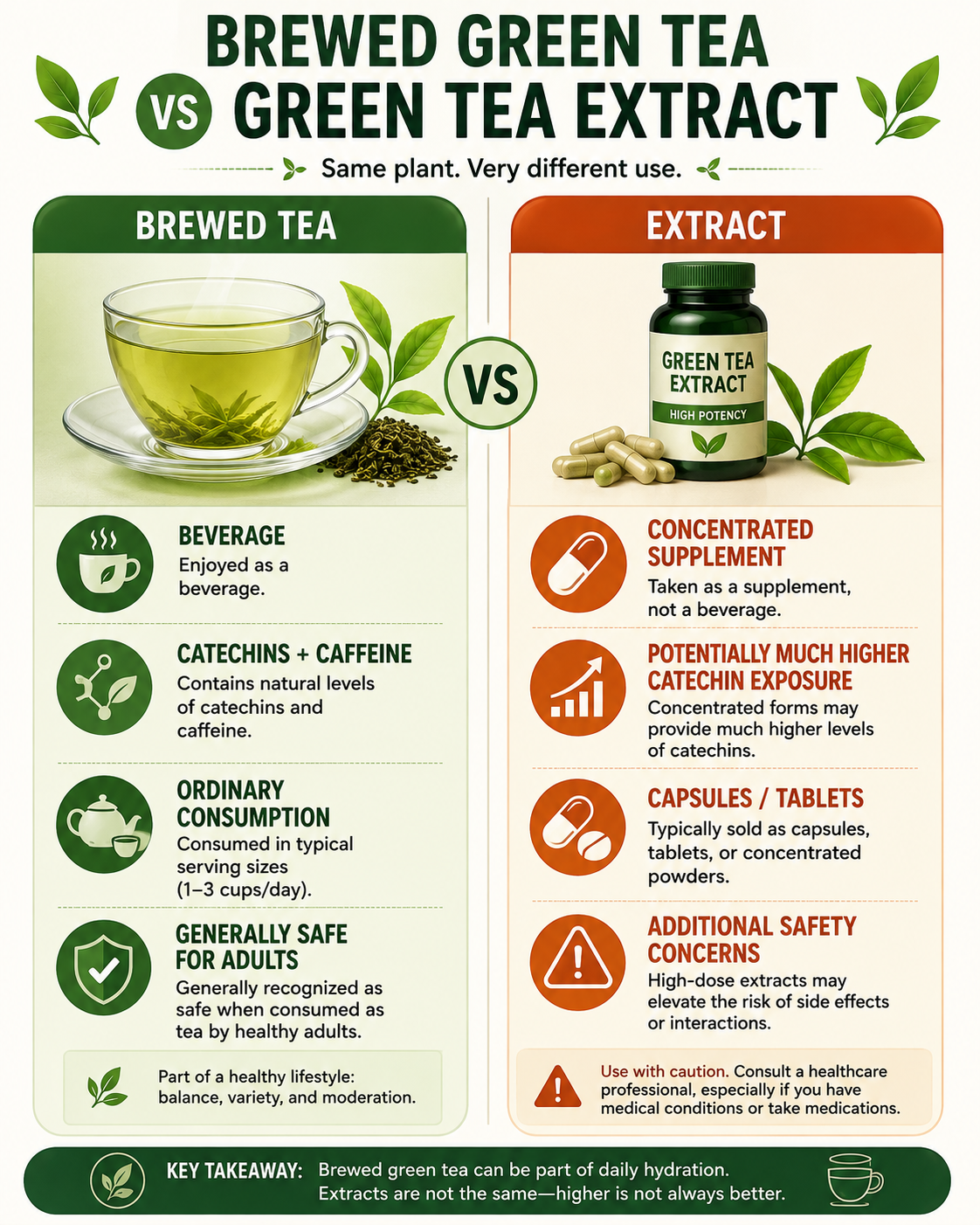
Green Tea vs. Green Tea Extract: They Are Not the Same
This distinction is essential.
| Brewed green tea | Green tea extract |
|---|---|
| Ordinary beverage | Concentrated supplement |
| Usually consumed as a drink | Often supplied as capsules or tablets |
| Contains naturally occurring catechins and caffeine | May contain concentrated catechins |
| Generally safe for adults as a beverage | Has additional safety concerns |
| Easy to incorporate into meals/routines | Requires more careful consideration |
| Not a proven weight-loss treatment | Not a proven weight-loss treatment |
NCCIH reports no safety concerns for green tea consumed as a beverage by adults, although it contains caffeine. In contrast, side effects have been reported with green tea extracts, and uncommon liver injury has been associated primarily with extract products in tablet or capsule form. NCCIH — Green Tea
NIH ODS also distinguishes the beverage from green tea extract and reports possible adverse effects associated with concentrated extracts. NIH ODS
This means:
A stronger supplement is not automatically a better version of the drink.
Can Green Tea Burn Belly Fat?
This is one of the most common questions surrounding weight-loss teas.
The short answer is
Do not expect green tea to selectively burn abdominal fat.
Body fat is not removed according to where you want it to disappear.
Some research has examined changes in waist circumference or visceral fat, but that does not mean green tea specifically targets belly fat.
Healthline’s review describes the effects on actual weight as relatively modest, despite research interest in visceral fat. Healthline
A more accurate statement is:
Green tea may have a small effect on some measures of body composition, but it should not be marketed as a belly-fat burner.
What Green Tea Cannot Do
Myth 1: Green tea melts belly fat
Reality: There is no established method by which drinking green tea selectively removes abdominal fat.
Myth 2: More cups mean faster weight loss
Reality: More is not necessarily better. Increasing caffeine intake can also increase unwanted effects in sensitive people.
Myth 3: EGCG is a powerful fat-burning drug
Reality: EGCG is biologically active and scientifically interesting, but that does not mean taking more produces dramatic weight loss.
Myth 4: Green tea replaces exercise
Reality: It does not.
Myth 5: Green tea works even if your overall diet remains unchanged
Reality: A beverage cannot compensate for an overall pattern that consistently provides more energy than your body needs.
Myth 6: Green tea extract is simply stronger tea.
Reality: Extracts are concentrated supplements with a different safety profile.
NCCIH specifically advises caution with green tea supplements and notes potential interactions with certain medicines. NCCIH
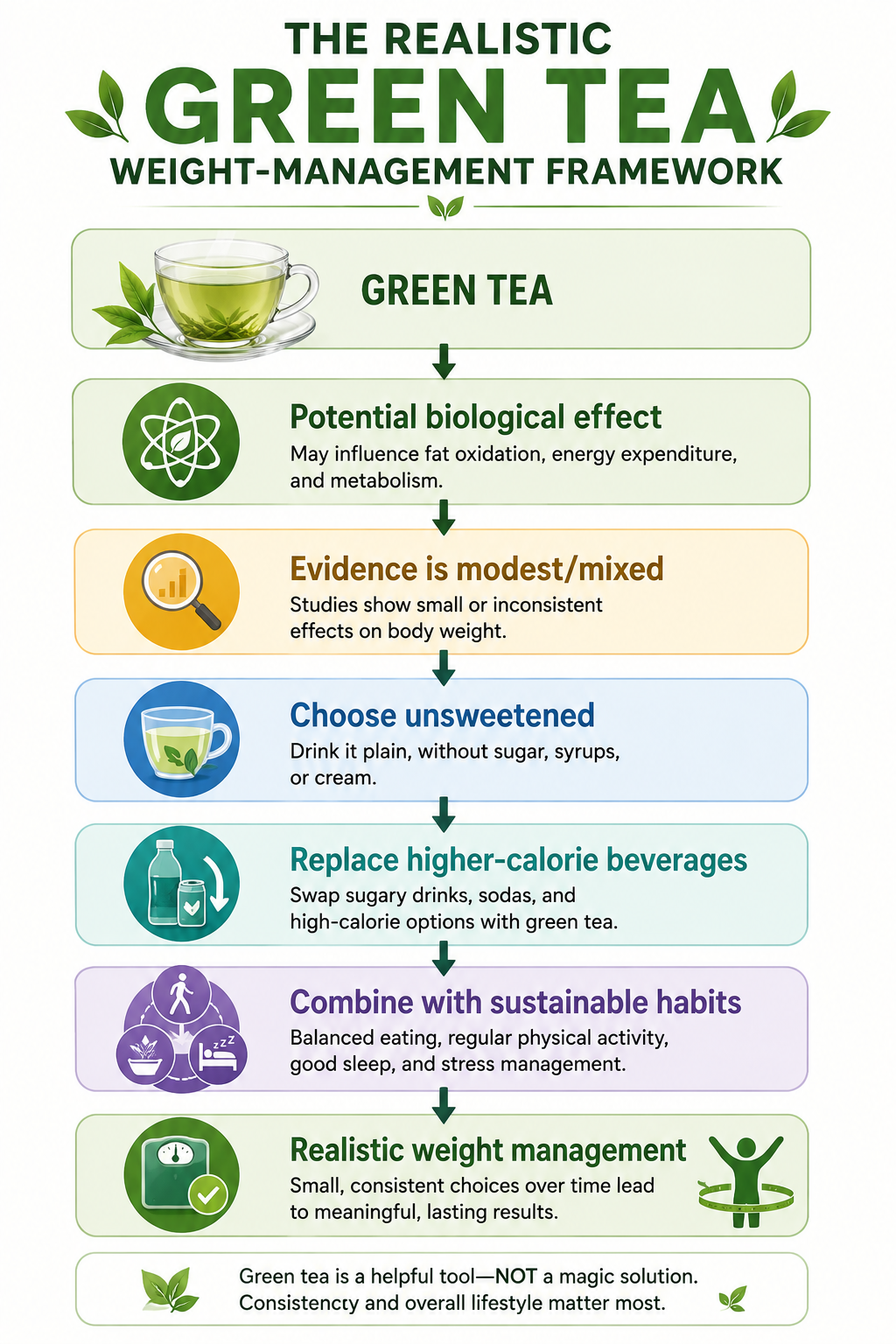
How to Use Green Tea Realistically for Weight Management
If you enjoy green tea, you do not need to turn it into a complicated weight-loss program.
A practical approach is
- Choose unsweetened green tea if you enjoy the taste.
- Use it as an alternative to higher-calorie beverages when appropriate.
- Pay attention to caffeine if it affects your sleep.
- Do not use green tea as a meal replacement.
- Do not assume that adding more cups will accelerate weight loss.
- Do not rely on concentrated extracts simply because they contain more catechins.
- Keep your overall eating pattern and physical activity in focus.
The goal is not to squeeze every possible calorie-burning effect from a cup.
The goal is to make a beverage choice that fits your life.
When Green Tea May Not Be the Right Choice
Green tea contains caffeine, so it may not suit everyone equally well.
You may need to discuss green tea or supplements with a healthcare professional if you:
- take prescription medicines
- are pregnant or may become pregnant
- are breastfeeding
- have a medical condition affected by caffeine
- are considering concentrated green tea extract
- have concerns about liver health
NCCIH reports potential interactions involving green tea or extracts with medicines including nadolol, atorvastatin, and raloxifene and recommends discussing supplements with healthcare professionals. NCCIH
This does not mean ordinary green tea is dangerous for everyone.
It means the beverage and concentrated supplements should not be treated as identical products.
Should You Add Green Tea to Your Weight-Management Routine?
Here is a simple way to think about it.
Green tea may make sense if:
- You enjoy drinking it.
- You can drink it without large amounts of added sugar.
- It helps replace a higher-calorie beverage.
- Caffeine does not interfere with your sleep or cause other problems.
- You understand that any direct weight effect is likely to be modest.
Think twice about concentrated supplements if:
- You are taking prescription medicines.
- You have a medical condition that may affect supplement safety.
- You are attracted to a product promising rapid weight loss.
- The product contains multiple stimulants.
- The label makes dramatic claims about “melting fat.”
NIH ODS warns that many weight-loss supplements have limited evidence and that some can interact with medicines or cause harm. NIH ODS Consumer Fact Sheet
A Better Way to Think About Green Tea and Weight
Rather than asking:
“How many calories does green tea burn?”
Try these questions:
Question 1
What does the evidence actually show?
Question 2
How large is the effect?
Question 3
Was the research performed using brewed tea or an extract?
Question 4
What else changed in the participants’ lifestyles?
Question 5
Is the product safe for me?
Question 6
Can this habit realistically continue for months or years?
This approach moves the conversation away from miracle claims and toward something much more useful:
realistic expectations.
Frequently Asked Questions
Does green tea help with weight management?
It may contribute to a small effect on body weight, particularly because of its catechins and caffeine, but the evidence is mixed, and the expected effect is modest. NIH ODS
Can green tea help you lose weight?
Possibly, but it should not be considered a standalone weight-loss treatment. NIH ODS describes the potential effect as modest, while research reviews have reported mixed findings. NIH ODS Healthline
Does green tea burn belly fat?
There is no good basis for saying that green tea selectively burns belly fat. Some studies have examined waist circumference and visceral fat, but this is different from proving spot fat loss.
Does EGCG burn fat?
EGCG has been studied for possible effects on fat oxidation and energy expenditure, but biological activity does not mean that EGCG produces dramatic fat loss in everyday life. NIH ODS
Is green tea better than coffee for weight loss?
There is not enough evidence to declare one universally better. Both contain caffeine, while green tea also provides catechins. The better choice depends on your preferences, tolerance, and how the beverage fits into your overall diet.
Should I drink green tea before exercise?
There is research investigating green tea and exercise-related fat oxidation, but results are mixed. Green tea should not be viewed as a requirement for an effective workout. Healthline
Is green tea extract better than brewed green tea?
Not necessarily. Green tea extracts are concentrated supplements and have additional safety considerations. NCCIH reports that uncommon liver injury has been associated primarily with extract products. NCCIH
Is green tea safe to drink every day?
For most adults, green tea consumed as a beverage has not raised major safety concerns, although it contains caffeine. Individual tolerance varies. NCCIH
Can I drink green tea at night?
You can, but caffeine may interfere with sleep in some people. If you notice that evening green tea makes it harder to sleep, consider drinking it earlier or choosing a caffeine-free alternative.
Can green tea replace exercise or a healthy diet?
No. Green tea may be one small part of a healthy routine, but it cannot replace the broader behaviors involved in sustainable weight management.
Final Thoughts
Green tea has earned its reputation as a health-focused beverage, but the weight-management story is more nuanced than many headlines suggest.
The research gives us a reasonable middle ground.
Green tea contains catechins such as EGCG and caffeine, and these compounds may influence energy expenditure and fat oxidation. Some studies and reviews suggest a small effect on body weight. At the same time, the evidence is mixed, and authoritative NIH resources describe the potential weight effect as modest, not dramatic. NIH ODS NCCIH
For me, the most practical lesson is not that green tea is a powerful fat burner.
It is that a simple beverage can sometimes support a better routine.
If unsweetened green tea replaces a sugary drink, helps you make a lower-calorie beverage choice, and fits comfortably into your daily life, it can have a useful place in a weight-management plan.
But the tea should remain one small piece of the picture.
The bigger picture is your overall eating pattern, physical activity, sleep, consistency, and—when needed—professional guidance.
Green tea may help a little. Sustainable habits do much more.
Author Note
RVLNSV PRASAD writes health and wellness content with an emphasis on practical, evidence-informed information for everyday readers.
For this article, information about green tea, weight management, dietary supplements, and safety was reviewed against authoritative sources, including the National Center for Complementary and Integrative Health (NCCIH), the National Institutes of Health Office of Dietary Supplements (NIH ODS), and peer-reviewed research.
Personal experience in this article is presented as personal experience and should not be interpreted as scientific evidence.
Medical Disclaimer
This article is intended for general educational purposes and does not diagnose, treat, prevent, or cure any medical condition.
Green tea is not a substitute for professional medical care, a balanced eating pattern, physical activity, or prescribed treatment. Concentrated green tea extracts can have different safety considerations from brewed tea and may interact with medicines.
If you take prescription medicines, have a medical condition, are pregnant or breastfeeding, or are considering a concentrated green tea supplement, consult a qualified healthcare professional before using it.
Sources
- National Center for Complementary and Integrative Health (NCCIH) — Green Tea: Usefulness and Safety
https://www.nccih.nih.gov/health/green-tea - NIH Office of Dietary Supplements — Dietary Supplements for Weight Loss: Health Professional Fact Sheet
https://ods.od.nih.gov/factsheets/WeightLoss-HealthProfessional/ - NIH Office of Dietary Supplements — Dietary Supplements for Weight Loss: Consumer Fact Sheet
https://ods.od.nih.gov/factsheets/weightloss-consumer/ - Healthline — How Green Tea Can Help You Lose Weight
https://www.healthline.com/nutrition/green-tea-and-weight-loss - Healthline — 10 Evidence-Based Benefits of Green Tea
https://www.healthline.com/nutrition/top-10-evidence-based-health-benefits-of-green-tea - Healthline — The 6 Best Teas to Lose Weight and Belly Fat
https://www.healthline.com/nutrition/weight-loss-tea - PubMed — Recent systematic review/network meta-analysis of tea and weight-related outcomes
https://pubmed.ncbi.nlm.nih.gov/39497467/ - PubMed — Green tea catechins and body-weight-related outcomes
https://pubmed.ncbi.nlm.nih.gov/19906797/
More Stories From This Blog
- 10 Best Herbal Remedies to Control Diabetes
- Best 8 Weight Loss Exercises
- 7 Cancer Fighting Foods Include in Your Diet
- 10 Best Herbal Teas for Calming the Mind:A Comprehensive Guide Natural Stress Relief
- 12 Best Fat Burning Supplements Women









[…] 12 Benefits Of Green Tea For Weight Loss […]
[…] 12 Benefits Of Green Tea For Weight Loss […]
[…] 12 Benefits Of Green Tea For Weight Loss […]
[…] 12 Benefits Of Green Tea For Weight Loss […]